 Cart is empty
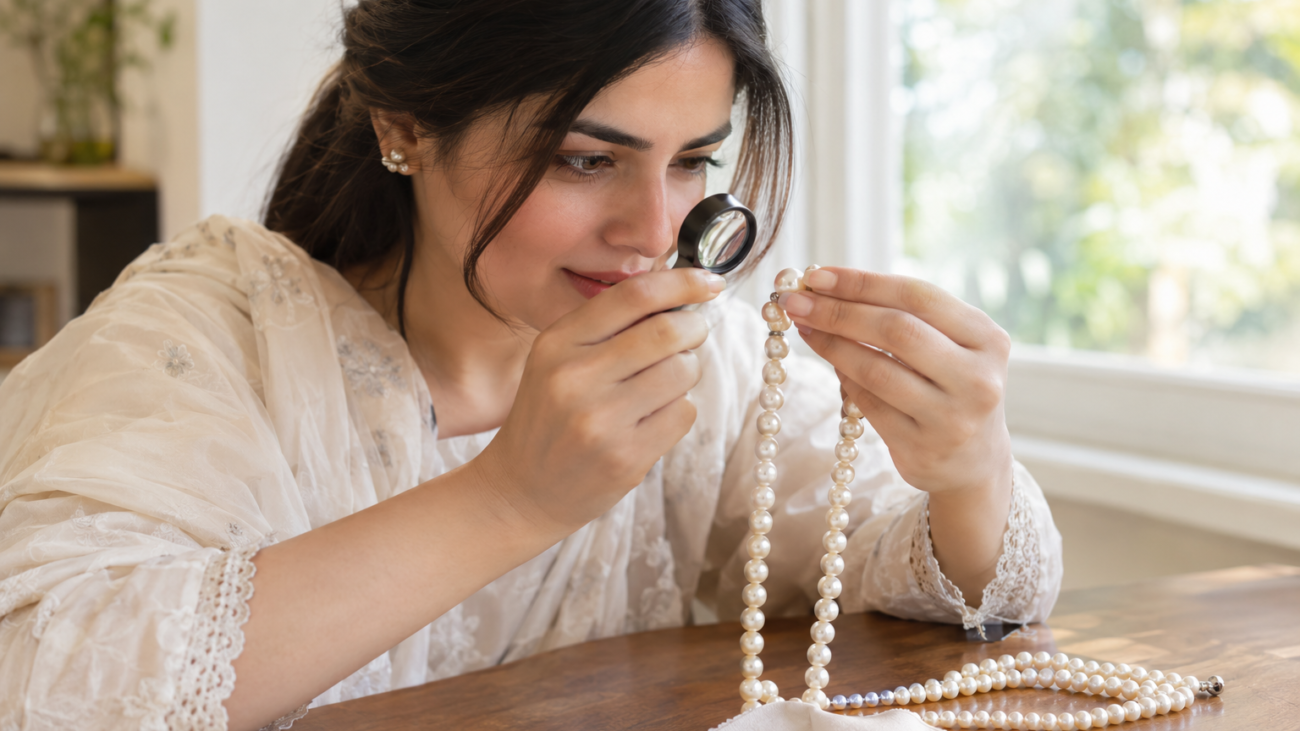
Real vs fake pearls is easier to judge than most people think. Rub the pearl lightly on the edge of your tooth. Real pearls feel gritty, while fakes feel smooth. Then check the drill hole, weight, surface and shine. No single test is perfect, so use at least three before you decide.
Imagine you are buying a gift for Eid or a wedding. The seller says “real pearl.” How do you know? You do not need a lab for a first check. You need your eyes, your fingertips and about ten minutes.
Is a “fake” pearl always a bad thing?
Not always. Let me clear up one common mix-up first. GIA says cultured pearls are real pearls, grown on farms with human help. In fact, most pearls in the jewellery market today are cultured. Imitation pearls are different. They are made from glass, plastic, alabaster or shell, then coated to look like pearls.
Here is my stance. Imitation pearl jewellery is perfectly fine when the seller says so honestly. The real problem is a wrong label. So the goal of these tests is not to shame fakes. It is to know exactly what you are paying for.
What are the 7 easy tests for real vs fake pearls?
Do the tests in this order. Be gentle, because pearls are soft and scratch easily. GIA ranks pearl at 2.5 on the Mohs scale.
1. The tooth test
Wipe the pearl clean. Then rub it lightly across the biting edge of a front tooth. Do not bite it. A real pearl feels gritty, like fine sand. A fake usually feels smooth and glassy. A light rub like this should not scratch the pearl.
2. The two-pearl rub
Rub two pearls gently against each other. Real pearls create slight friction and may leave a fine powder. Fakes tend to slide without resistance. Keep it very light, and only try it on pearls you own.
3. The surface check
Look closely in bright daylight, ideally with a magnifier. Real pearls show tiny ridges and small natural flaws. A perfectly smooth, flawless surface is often a warning sign. On a full strand, real pearls also vary a little in shape, size and colour.
4. The drill-hole check
Look at the hole where the thread passes through. Real pearls have clean, crisp holes, and you may see a thin ring of nacre. Fakes may show chipped paint, peeling coating or a melted-plastic look around the hole.
5. The weight check
Hold the pearl in your palm. Real pearls feel heavy for their size. Fakes often feel lighter or hollow. This works best when you can compare with a pearl you already trust.
6. The temperature check
Touch the pearl to your cheek or wrist. A real pearl feels cool at first and warms up slowly. A fake often feels room temperature straight away. However, glass fakes also feel cold, so treat this as a weak clue.
7. The shine check
Real pearls have a deep, reflective glow. Fakes often look dull or almost matte. Tilt the pearl under a light and watch how the glow moves across the surface.
Which real vs fake pearls tests can fool you?
Some fakes now have a gritty coating, so they can pass the tooth test. That is why one test is never enough. Here is my rating of each test.
| Test | How much I trust it | Why |
|---|---|---|
| Tooth test | Good, not perfect | Coated fakes can feel gritty |
| Two-pearl rub | Good | Real pearls show friction |
| Surface check | Medium | Some fakes look imperfect |
| Drill-hole check | Good on strung pearls | Needs a clear close-up |
| Weight check | Medium | Needs a comparison pearl |
| Temperature check | Low | Glass is cold too |
| Shine check | Medium | Good imitations can glow |
What is my simple pass-count rule?
My rule for real vs fake pearls is simple. Score each test as a pass or a fail. If a pearl fails three or more tests, I treat it as imitation. If the results are mixed, show it to a jeweller before you pay.
Also know the limits. These tests can separate pearls from imitations. They cannot tell natural pearls from cultured ones. GIA explains that natural and cultured pearls often look the same outside and may need internal examination. Visual checks alone are often not enough to name the exact pearl type.
How can you check pearls before buying online?
Online shopping makes testing impossible, so ask the right questions instead.
- Ask the seller what the pearl is made of: cultured freshwater, shell-based or imitation.
- Ask for a daylight close-up photo or video of the drill hole and surface.
- Check the return and exchange policy before you pay.
- Be careful with a “natural pearl” claim at a tiny price. GIA says natural pearls are very rare, and most on the market today are antiques.
- For an expensive piece, ask for a lab report from a respected lab such as GIA.
Which “tests” should you avoid?
Some online tests can ruin a good pearl. For example, dropping a pearl in vinegar or lemon juice is a bad idea. GIA says all acids can damage pearl, so skip those tests.
Also avoid biting hard. The tooth test is a light rub, not a bite. Finally, never judge a pearl by a single result. Use the pass-count rule instead.
Ready to choose your pearl jewellery?
Now you know the real vs fake pearls signs, so shop with confidence. Browse our pearl [necklaces], [bracelets] and [rings].
How can I tell real vs fake pearls at home?
Rub the pearl lightly against the edge of your tooth. Real pearls feel gritty, and fakes feel smooth. Then check the drill hole for clean edges, compare the weight, inspect the surface for tiny flaws, and look at the shine. Use at least three tests together.
Does the tooth test damage pearls?
A gentle rub should not damage a pearl. The test is not a bite. Wipe the pearl first, use very light pressure, and stop if the surface feels fragile. Pearls are soft, so never rub hard.
Are cultured pearls real pearls?
Yes. GIA says cultured pearls grow in pearl farms through human intervention, and most pearls in the jewellery market are cultured. Imitation pearls are different, because they are made from materials like glass, plastic or coated shell.
Can fake pearls pass the tooth test?
Some can. Certain fake pearls have a gritty coating that feels like real nacre against a tooth. That is why you should also check the drill hole, weight and surface. If you are still unsure, ask a jeweller.
Can I tell natural pearls from cultured pearls at home?
No. GIA says natural and cultured pearls can look alike on the outside and sometimes need internal examination. Home tests only help separate pearls from imitations. For a natural pearl claim, ask for a lab report.
How do I know if online pearl jewellery is real?
Ask the seller for the exact material, a daylight close-up of the drill hole, and the return policy. Be careful with very low prices for “natural pearls.” For costly pieces, ask for a report from a respected lab.